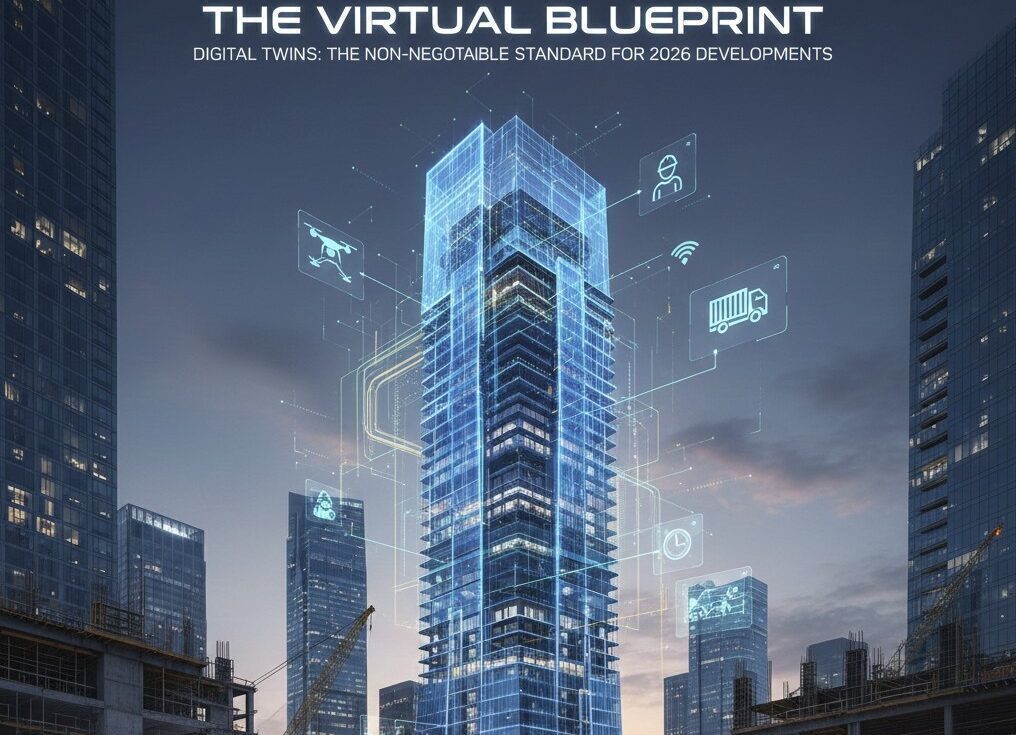
The year 2026 has ushered in a new era for real estate development. The days of siloed information, reactive problem-solving, and budget overruns are rapidly becoming relics of the past. As projects become increasingly complex, regulations tighten, and client expectations rise, the industry demands a level of precision and foresight that was previously unimaginable.
Enter the Digital Twin: not just a fancy buzzword, but the invisible backbone of every successful development in 2026. This isn’t just about 3D models; it’s about a living, breathing virtual replica of a physical asset, powered by real-time data and predictive AI. For today’s developers, it’s no longer a luxury—it’s the non-negotiable standard.
Beyond BIM: The Evolution to a Living Model
Building Information Modeling (BIM) laid the groundwork by centralizing design data. Digital Twins take this to an entirely new dimension. Imagine BIM, but constantly updated with live data from sensors, construction progress reports, and even external factors like weather and supply chain fluctuations.
What is a Digital Twin in 2026? It’s a dynamic virtual model that mirrors its physical counterpart throughout its entire lifecycle. During construction, it receives data from:
- On-site sensors: Tracking equipment, material placement, and environmental conditions.
- Worker wearables: Monitoring safety compliance and efficiency.
- Drones & Lidar: Capturing daily progress scans.
- Supply chain APIs: Providing real-time updates on material delivery.
Once operational, the Digital Twin continues to evolve, fed by data from:
- IoT sensors: Monitoring HVAC, lighting, security, and occupancy.
- Building Management Systems (BMS): Providing performance analytics.
- Maintenance logs: Tracking repairs and lifecycle costs.
Minimizing Delays: Predictive AI as Your Crystal Ball
The most significant drain on construction projects has always been the unpredictable delay. Digital Twins, combined with predictive AI, offer a powerful solution.
- Proactive Conflict Resolution: The Digital Twin can run thousands of simulations. If an HVAC duct clashes with a structural beam in the virtual model, it’s caught and resolved before a single physical pipe is cut. Predictive AI can even flag potential clashes based on planned installation sequences.
- Supply Chain Resilience: Integrated with live global logistics data, the Digital Twin can predict potential delays for critical materials. If steel rebar from a specific supplier is held up in port, the AI can immediately suggest alternative suppliers, re-sequence tasks, or adjust the timeline, giving project managers days, even weeks, of lead time.
- Resource Optimization: AI analyzes historical data and real-time progress to predict optimal staffing levels and equipment allocation. It can flag if a crane will be idle due to material delays or if a specific trade is falling behind schedule, allowing for immediate intervention.
- Weather Impact Forecasting: Beyond simple rain delays, predictive AI uses hyper-local weather models to anticipate how temperature, wind, or humidity might impact concrete curing times, paint application, or even drone flight operations, enabling schedules to adapt proactively.
Optimizing Building Performance: The “Cognitive Building” Advantage
The benefits of a Digital Twin extend far beyond project completion, fundamentally changing how buildings perform.
- Energy Efficiency: By integrating with BMS and IoT sensors, the Digital Twin creates a “cognitive building” that learns. It can predict peak energy demand, optimize HVAC schedules based on actual occupancy (not just assumptions), and even identify faulty equipment before it fails, leading to significant operational savings—often 20-30% in energy costs alone.
- Predictive Maintenance: No more reactive repairs. The Digital Twin monitors the wear and tear on critical assets (elevators, chillers, pumps). AI algorithms analyze performance data to predict when a component is likely to fail, proactively scheduling maintenance, reducing downtime, and extending asset lifespans.
- Occupant Comfort & Wellness: Air quality, lighting, and temperature can be fine-tuned based on real-time feedback and learned patterns. The Digital Twin helps create adaptive environments that respond to user needs, enhancing tenant satisfaction and well-being.
- Space Utilization: For commercial or mixed-use properties, the Twin Tracks occupancy patterns are used to optimize space use. It can inform flexible office layouts, dynamic pricing for shared amenities, or even future expansion plans based on actual usage data.
The Non-Negotiable Standard
In 2026, the competitive edge belongs to those who build smarter, not just faster. Digital Twins, empowered by predictive AI, are no longer a luxury—they are foundational to minimizing risk, maximizing efficiency, and delivering high-performing, sustainable assets.
Investing in a Digital Twin strategy from the outset is investing in a future where your blueprint isn’t just a plan, but a promise of precision, performance, and unparalleled peace of mind.
What are your thoughts on integrating Digital Twins into your next project pipeline? Share your perspective!
🏗️#DigitalTwins #SmartBuildings 🌍#SustainableDevelopment #NetZeroBuildings #GreenBuilding 📈#BuildingTheFuture #TechTrends2026 #VirtualBlueprint