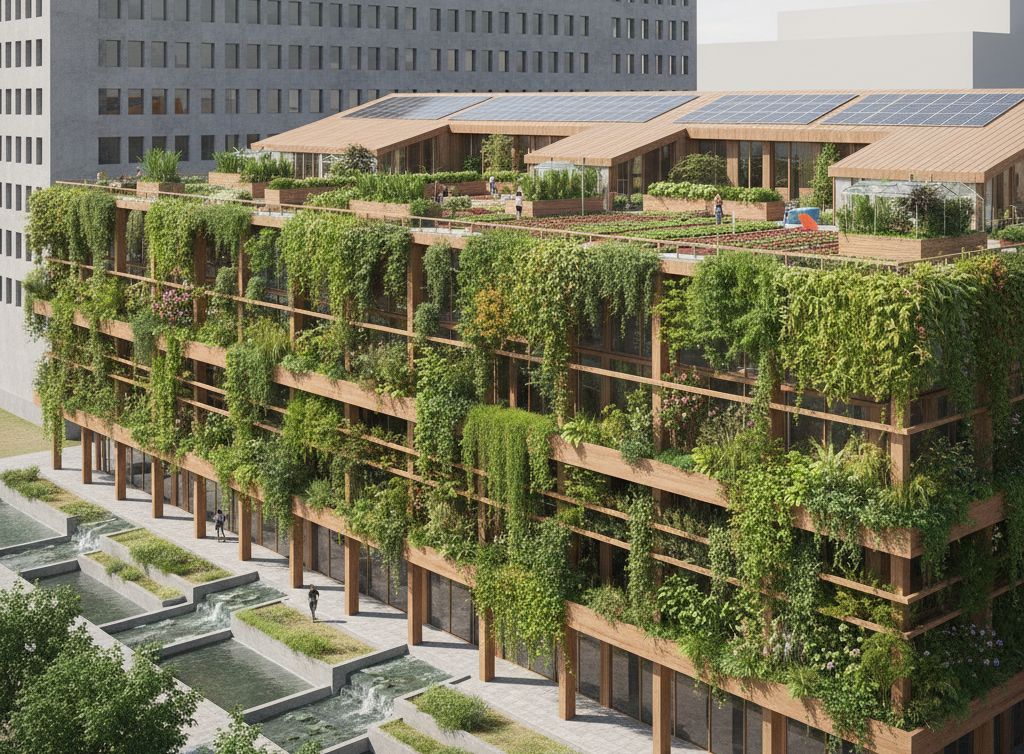
For decades, the gold standard of responsible development was “sustainability.” We aimed for “net zero” – a neutral footprint where we did as little harm as possible. We celebrated the use of low-flow toilets, LED lighting, and recycled carpet tiles. However, as we move into 2026, the conversation has undergone a fundamental shift. In an era of accelerating climate volatility and biodiversity loss, simply being “less bad” is no longer enough.
The real estate industry is undergoing a paradigm shift from Green Building to Regenerative Development. This isn’t just a linguistic tweak; it is a move from neutrality to net-positivity. While green buildings seek to limit their impact, regenerative projects are designed to act like living organisms that actively restore the local ecosystems they inhabit.
From “Doing Less Harm” to “Doing More Good”
Traditional green building is often reductive. It focuses on efficiency: using less energy, less water, and fewer raw materials. Regenerative development, by contrast, is additive. It asks: How can this building produce more energy than it consumes? How can it purify the local watershed? How can it increase the bird and pollinator population in this specific zip code?
Key pillars of this transition include:
- Living Systems Integration: Moving beyond aesthetic “green walls” to functional biodiversity. This includes urban agriculture, “sponge city” water management that restores local hydrology, and habitats for native species.
- Carbon Sequestration: Shifting from low-carbon materials to carbon-storing ones, such as mass timber, hempcrete, and CO₂-infused concrete, effectively turning buildings into carbon sinks.
- Design for Disassembly: Embracing a circular economy where buildings are viewed as “material banks,” designed to be taken apart and reused rather than demolished.
The New ROI: Beyond the Utility Bill
Critics once argued that regenerative features were “gold-plating” a project – expensive additions with no clear return. Today’s market proves otherwise. The ROI of regenerative real estate is being rewritten through the lens of ESG (Environmental, Social, and Governance) performance.
1. The “Green Premium” and “Brown Discount”
Data from 2024 and 2025 indicate that assets with high-level regenerative certifications (like the Living Building Challenge) command significantly higher rents and occupancy rates. Conversely, traditional buildings are increasingly subject to a “brown discount” – devaluing as they fail to meet new carbon regulations and tenant expectations.
2. Resilience as Risk Mitigation
Regenerative projects are inherently more resilient. A building that manages its own water through constructed wetlands is less vulnerable to urban flooding. A building with a decentralized microgrid and passive thermal design can stay operational during power outages. For institutional investors, this represents a massive reduction in long-term climate risk.
3. Human Capital and Social ROI
The “S” in ESG is finding a home in regenerative design. Biophilic environments – those that reconnect people with nature – are proven to reduce stress, improve cognitive function, and increase productivity. In the commercial sector, this translates to lower employee turnover and higher tenant retention. We are seeing a shift where the “Social ROI” is measured in the health and vitality of the community the building supports.
Regenerative Real Estate in Action
Regenerative projects are already proving their worth globally. Kampung Admiralty in Singapore functions as a “vertical village” that integrates healthcare, housing, and a lush rooftop farm, achieving a green plot ratio of over 100%. In London, the King’s Cross Regeneration transformed industrial wasteland into a vibrant ecological spine for the city.
The Bosco Verticale (Vertical Forest) in Milan isn’t just an aesthetic marvel; its 900+ trees act as a micro-ecosystem that filters CO2 and dampens urban noise, all while supporting hundreds of species of birds and insects. In Seattle, the Bullitt Center – often called the greenest commercial building in the world – operates on a scale of “ecosemantics,” where every drop of rain is treated as a resource rather than waste. These aren’t just buildings; they are ecological engines.
The Path Forward
The transition to regenerative real estate requires a shift in mindset. It requires developers to stop seeing a plot of land as a blank slate and start seeing it as a complex, living system. It requires architects to move from “ego-design” to “eco-design.”
As we look toward the 2030 climate milestones, the winners in the real estate market will be those who stop asking “What is the minimum we can do?” and start asking “What is the most we can give back?”
#RegenerativeRealEstate #SustainableDevelopment #GreenBuilding #FutureOfRealEstate #ESG #GreenPremium #LivingBuilding #UrbanEcology