The Opportunity is Now—But So is the Competition
The glamping market is exploding. The global industry is projected to scale from $3.8 billion to over $9 billion by 2034, maintaining a fierce 11–12% annual growth rate. Driven by Millennials and Gen Z, modern travelers are seeking immersive, nature-based experiences without sacrificing luxury.
Crucially, direct bookings now account for over half of all glamping reservations. Guests want to buy directly from the source.
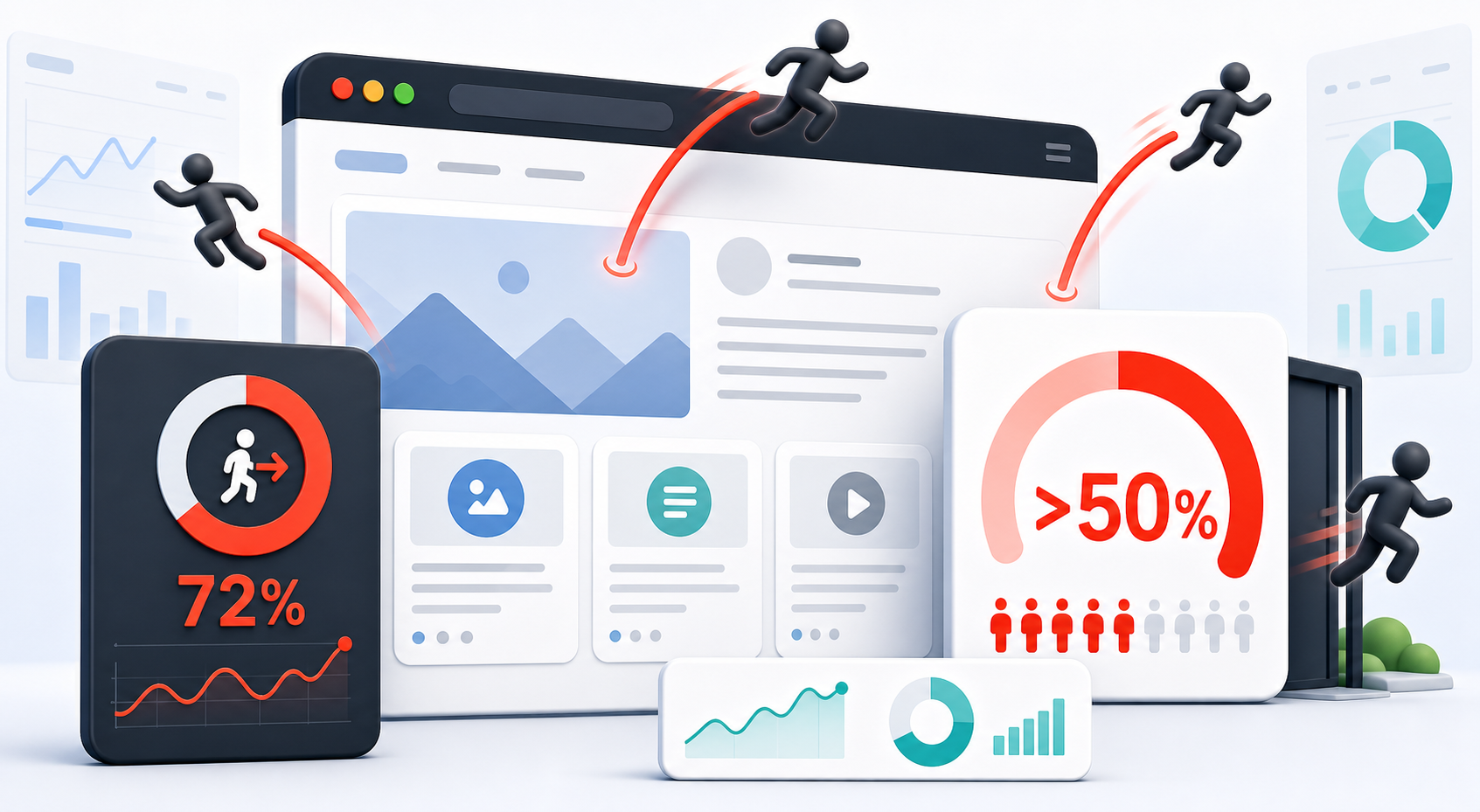
But here is the hard truth: Most glamping operators are completely invisible to search engines.
They are losing the battle against Airbnb, Hipcamp, and Booking.com because their digital presence isn’t optimized to capture organic traffic. This comprehensive guide from the team at Xplore Digital Media shows you how to rank for high-intent searches, dominate local results, and convert casual searchers into highly profitable direct bookings.
The Economics of Search: Why SEO Rules Modern Hospitality
The Direct Booking Advantage
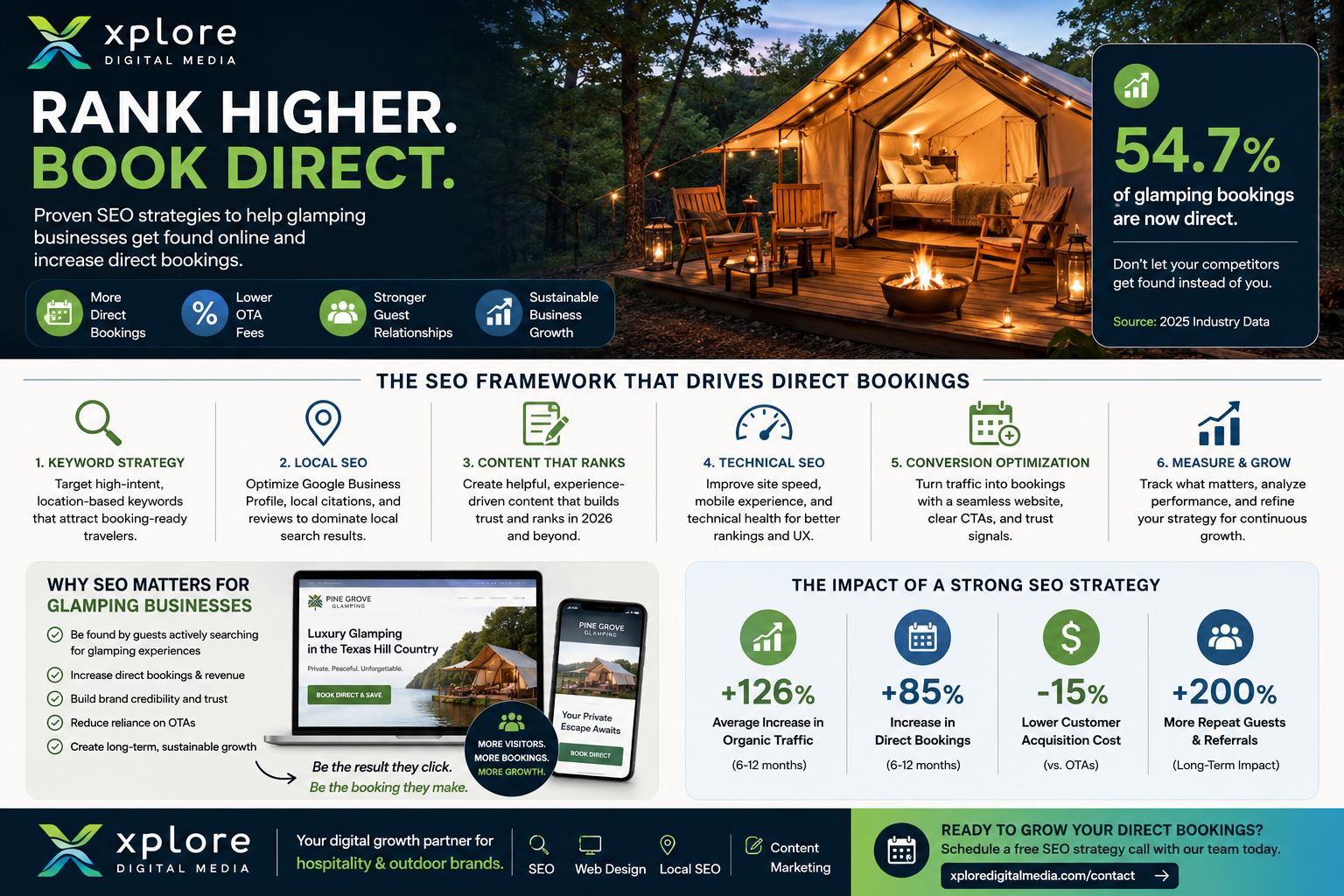
According to recent hospitality data, direct bookings account for roughly 54.7% of glamping reservations in mature markets. When you bypass Online Travel Agencies (OTAs) and own the guest relationship, you:
- Keep 100% of your revenue (Avoiding OTA commissions that range from 10% to 15.5%).
- Control the guest experience and fully dictate your brand perception.
- Build an owned email database for seamless remarketing, seasonal promotions, and upsells.
- Insulate your business from sudden OTA algorithm shifts that can erase your visibility overnight.
But guests don’t find your booking engine by accident. If your site doesn’t rank on the first page of Google, your prospective guests will book with your competitors on Airbnb instead.
The Modern Ranking Reality: E-E-A-T, Speed, and Meaning
Google’s algorithm favors comprehensive, human-centric experiences. Three pillars dictate whether your glamping site ranks:
- E-E-A-T (Experience, Expertise, Authoritativeness, Trustworthiness): Google prioritizes first-hand human experience. For glamping sites, this means showcasing authentic guest reviews, transparent sustainability practices, and clear operator profiles.
- Technical Performance (Core Web Vitals): Sites that take longer than 2.5 seconds to load lose over 23% of their traffic. Interaction to Next Paint (INP) and mobile responsiveness are now massive ranking signals.
- Semantic Search: Exact keyword matching is a relic of the past. Google now evaluates topical depth, intent, and context. A basic “brochure” website is no longer enough to compete.
Wondering how your glamping site scores on Google’s technical scale? Let our team run a complimentary technical audit on your site. Get Your Free Custom Report at Xplore Digital Media.
Setting the Foundation: Essential On-Page Adjustments
1. Keyword Strategy: Target High-Intent Searchers
Generic keywords like “glamping” are incredibly competitive and rarely convert. To win direct bookings, you must target long-tail, high-intent keywords that signal a traveler is ready to purchase.
| Generic (Low Conversion) | High-Intent (High Conversion) |
| Glamping | “Book [Property Name] glamping” |
| Luxury Camping | “[Location] luxury camping booking” |
| Glamping Cabins | “[Location] glamping with private hot tub” |
| Nature Retreat | “Eco-friendly glamping retreat for couples [Location]” |
The Strategy: Focus on adding location modifiers and specific amenity details (e.g., “luxury glamping with fire pit near Austin”). This captures users at the exact moment they are looking for your specific setup.
2. Page Titles & Meta Descriptions
These elements act as your organic digital billboard. Write them to entice clicks from real people, not just search bots.
- Weak Title: Home – My Glamping Site
- Optimized Title: Luxury Glamping in Texas Hill Country | Private Hot Tub & Fire Pit | [Property Name]
- Optimized Meta Description: Escape to an eco-friendly luxury camping oasis in Texas Hill Country. Private safari tents with hot tubs, farm-to-table dining, and direct trail access. Book your weekend getaway directly today.
3. Content Depth > Keyword Density
Google penalizes thin, generic, or mass-produced AI content. Your website copy must offer genuine value and detailed descriptions.
- What to avoid: “Glamping is glamorous camping. It combines luxury and nature. Our glamping site offers glamping near Austin. We have tents and cabins.”
- What to write instead: “Glamping near Austin shouldn’t mean roughing it. Our custom safari tents feature Egyptian cotton linens, private rainfall showers, and heated floors. Nestled on 15 acres of native oak forest, our property offers secluded views of a spring-fed creek. Located just 7 miles from Pedernales Falls, it’s the perfect launchpad for weekend adventurers looking for comfort at night.”
Mapping Your Ground: Dominating Local Search & Map Packs
Local search is where independent outdoor hospitality brands can successfully dethrone massive OTAs. Google heavily prioritizes local, proximity-based results for travel and accommodation queries.
1. Optimize Your Google Business Profile (GBP)
Your GBP is the anchor of your local search presence, feeding directly into Google Maps and the coveted “Local 3-Pack.”
- Complete Everything: Ensure your exact business name, phone number, address, and operating hours are completely filled out.
- Visual Assets: Upload 10+ high-resolution images of your accommodations, common areas, and surrounding landscape, alongside short video walkthroughs.
- Review Management: Actively solicit reviews and reply to them within 48 hours. Properties maintaining a 4.5-star rating or higher capture up to 35% more clicks than lower-rated competitors.
2. Maintain Local Citation Consistency
A citation is any online mention of your business Name, Address, and Phone number (NAP). Inconsistent data across the web signals to Google that your business might be unreliable or unverified.
Ensure your NAP data matches perfectly across:
- Google Business Profile & Yelp
- TripAdvisor & Hipcamp
- Local Chambers of Commerce and State Tourism Boards
3. Craft Localized Content Hubs
Build out pages that answer questions travelers ask while planning their trips. This positions your site as a regional authority.
- Neighborhood Guides: “Top 10 Things to Do Near [Your Town]”
- Seasonal Resource Guides: “The Ultimate Guide to Winter Wellness Retreats in [Your Region]”
- Activity-Specific Content: “Best Hiking Trails and Craft Breweries Near [Property Name]”
The Guest Journey: Crafting a High-Converting Content Funnel
To convert casual traffic into paid direct bookings, your content strategy needs to address users at every stage of the buyer’s journey.
Phase 1: Awareness (Attract)
- Goal: Capture high-volume, educational searches.
- Examples: “What is Glamping? A Beginner’s Guide to Luxury Camping” or “Why Glamping is the Ultimate Sustainable Tourism Choice.”
- Impact: Builds early brand awareness and site authority.
Phase 2: Consideration (Educate)
- Goal: Target users comparing their accommodation options.
- Examples: “Best Glamping Sites Near [City]: Amenities & Pricing Compared” or “[Location] Glamping with a Hot Tub: Our Top Accommodations.”
- Goal: Drive immediate reservations.
- Examples: Your highly optimized, dedicated accommodation pages, custom offer pages, and streamlined booking landing pages featuring prominent “Book Direct & Save” messaging.
Need a content strategy tailored specifically to your property? At Xplore Digital Media, we design custom keyword frameworks and high-converting content funnels that turn search traffic into revenue. Let’s build your content engine.
Behind the Scenes: Technical SEO Rules You Can’t Ignore
You can write spectacular copy, but if your website is slow, confusing, or broken on mobile devices, Google will rank your competitors ahead of you.
Core Web Vitals to Track
- Largest Contentful Paint (LCP): Measures loading performance. Your main content should load in under 2.5 seconds. Heavy, uncompressed image galleries are the primary culprit behind poor LCP scores in hospitality sites.
- Interaction to Next Paint (INP): Measures page responsiveness. Your site needs to respond to clicks in under 200 milliseconds.
- Cumulative Layout Shift (CLS): Measures visual stability. Content should never shift unexpectedly while loading, which commonly causes accidental clicks on mobile devices.
Advanced Weaponry: Schema Markup
Schema markup is backend code that explicitly tells search engine crawlers exactly what your business is. Implementing proper schema allows Google to display rich snippets (like star ratings, pricing, and availability) directly in the search results.
Your site requires specific structured data configurations, including:
- LocalBusiness Schema
- Accommodation (or Hotel) Schema
- Review and AggregateRating Schema
Implementing code like Schema and optimizing Core Web Vitals requires advanced technical expertise. Our specialized development team at Xplore Digital Media handles this heavy lifting for you, ensuring your site is fully optimized for Google’s latest standards.
Frictionless Revenue: Overcoming the Booking Engine Bottleneck
Why do glamping sites lose direct bookings to OTAs? Because their websites operate like static online brochures rather than dynamic booking engines.
Modern travelers expect an Airbnb-like booking experience:
- Instant, real-time calendar availability
- Transparent, upfront pricing quotes
- Frictionless, secure checkout in under 60 seconds
If your website requires users to fill out a long contact form and wait 24 hours for an email response to confirm availability, they will leave and book elsewhere.
The Multi-Channel Approach
While your primary objective should be scaling direct bookings via robust integrations (like Guesty, Hostaway, or dedicated booking engines), you shouldn’t abandon OTAs entirely. Use platforms like Airbnb, Hipcamp, and Google Vacation Rentals as “inventory insurance” to fill mid-week vacancies, while aggressively leveraging your website to secure highly profitable direct bookings for peak periods.
Outmaneuvering the Crowd: Winning Against Regional Competitors
You aren’t just competing with multi-billion dollar tech platforms; you are competing with the glamping property down the road.
Spotting Competitor Content Gaps
Run a search for [Your Location] glamping and dissect the top five organic results. Ask yourself:
- What unique amenities or local experiences are they failing to mention?
- Are their property photos outdated or lacking a cohesive aesthetic?
- Do they have an active blog, or has their site content sat static for years?
Lean Into Authentic Storytelling
OTAs cannot tell a deeply personal, localized story—but you can. Use your website to heavily emphasize your property’s specific sustainability initiatives (e.g., solar offsets, zero-waste principles), curated wellness offerings, partnerships with local artisans, and your founding journey. Google explicitly rewards this level of unique, localized value.
Blueprint for Success: Your 90-Day Action Plan
Executing an SEO strategy requires consistent, structured effort. Use this foundational quarterly roadmap to scale your organic visibility.
Month 1: The Technical & Local Foundation
- [ ] Claim, verify, and fully build out your Google Business Profile.
- [ ] Run a site speed audit and compress all large image assets (aim for LCP < 2.5s).
- [ ] Audit and align your business NAP consistency across all digital directories.
- [ ] Set up an automated post-stay email flow to consistently generate guest reviews.
Month 2: High-Intent Content Production
- [ ] Identify 5–10 long-tail, high-intent local keywords for your region.
- [ ] Rewrite your core accommodation pages to prioritize clarity, amenities, and depth.
- [ ] Publish 2 localized regional guides (e.g., “The Best Local Wineries & Hikes Near Us”).
- [ ] Internally link all new blog content directly back to your primary booking engine page.
Month 3: Authority Building & Optimization
- [ ] Launch a targeted review campaign to increase your Google Maps review volume.
- [ ] Add schema markup (LocalBusiness and Accommodation) to your core pages.
- [ ] Secure links from regional tourism directories and local business associations.
- [ ] Build clear, transparent author bios to satisfy Google’s E-E-A-T requirements.
Critical Traps to Avoid
- Keyword Stuffing: Writing for search bots instead of real travelers degrades your user experience and triggers search penalties.
- Neglecting Mobile Users: Over 50% of travel planning occurs on mobile devices. If your booking engine is difficult to navigate on a phone, your conversion rate will crater.
- Ignoring Negative Reviews: Leaving unfavorable reviews unaddressed hurts consumer confidence. Prompt, professional responses signal excellent customer care to prospective guests.
Elevate Your Bookings with Xplore Digital Media
Building a search engine presence that outranks multi-billion-dollar travel platforms requires time, precision, and deep technical expertise. As outdoor hospitality competition intensifies, leaving your search visibility to chance means leaving revenue on the table.
At Xplore Digital Media, we specialize in helping outdoor hospitality brands, luxury glamping resorts, and unique stays dominate search engines, maximize direct bookings, and cut down on costly OTA commissions.
Ready to fill your booking calendar? Contact Xplore Digital Media today