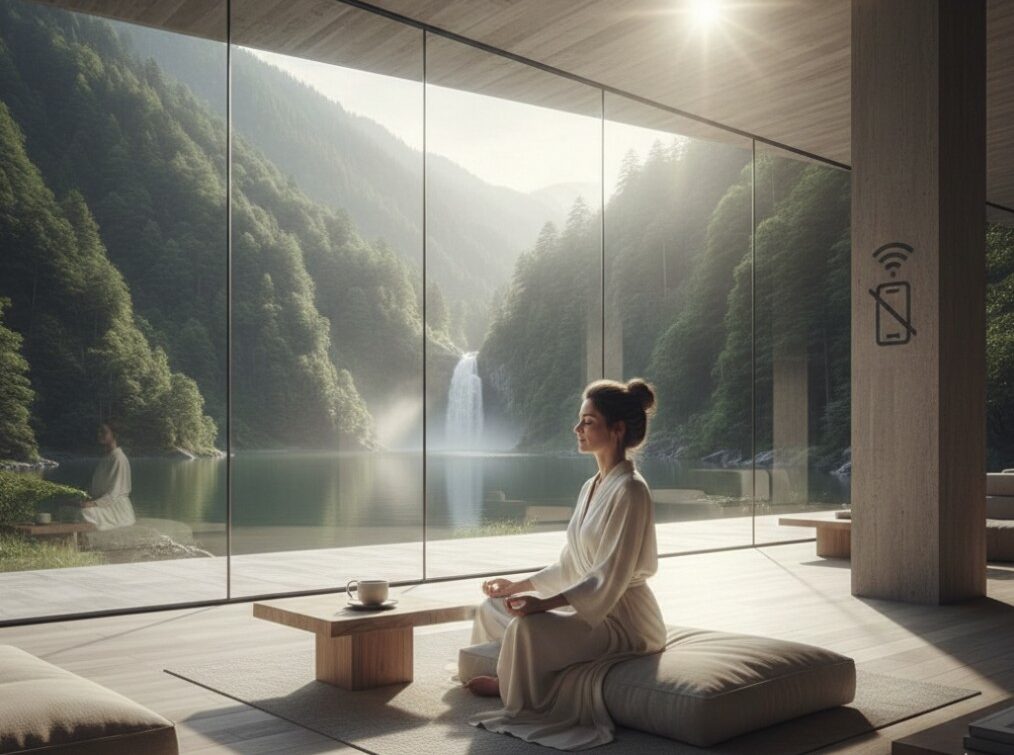
For decades, “luxury travel” was synonymous with excess. It was the gold-leafed ceiling, the five-man greeting party in the lobby, and the heavy, velvet-draped suites that whispered – or rather, shouted – opulence. But as we move through 2026, the roar of traditional luxury has been replaced by something much more expensive: absolute quiet.
In an era defined by constant connectivity, data harvesting, and the relentless “noise” of digital life, the most affluent travelers are no longer looking for more things. They are looking for less. Specifically, they are seeking the “Luxury of Silence” – a blend of minimalist aesthetics and radical privacy that allows for something increasingly rare: a moment of uninterrupted existence.
The Shift from “More” to “Meaningful”
The modern high-end traveler is suffering from “stimulus fatigue.” When your daily life consists of high-stakes decision-making and a barrage of notifications, the last thing you want on vacation is a complicated pillow menu or a butler who hovers.
Minimalism in the luxury sector isn’t about being “stark” or “cold.” It’s about intentionality. It is the architectural equivalent of a deep breath.
- Visual Silence: Design that emphasizes natural light, clean lines, and high-quality raw materials (stone, wood, linen).
- Cognitive Ease: Removing the “clutter” of choice. The best resorts now offer a curated, seamless experience in which experts make the decisions for you, leaving your brain free to wander.
- Invisible Service: The hallmark of 2026 luxury isn’t the staff you see; it’s the staff you don’t. It’s the room being refreshed while you’re at breakfast, or the drink appearing just as you realize you’re thirsty, all without a single intrusive “Is everything okay, sir?”
Privacy: The Ultimate Commodity
If minimalism is how a space looks, privacy is how it feels. In a world where your location is tracked and your preferences are sold, the ability to truly disappear is the highest form of wealth.
“Privacy is no longer just about a gated entrance; it is about digital and social invisibility. For the modern traveler, the most exclusive destination is the one that doesn’t show up on a ‘top ten’ list.”
Today’s luxury properties are pivoting toward “Radical Seclusion.” We are seeing a rise in:
- Buy-out Culture: Travelers booking entire small islands or boutique estates to ensure they only interact with their own inner circle.
- Digital Dead Zones: High-end retreats that offer signal-jamming (by request) or “tech-concierges” who manage your devices so you can experience a “clean” headspace.
- Anonymity as a Standard: Hotels that forgo the traditional check-in desk entirely, utilizing encrypted biometrics to allow guests to go from their private transport to their suite without ever seeing another soul.
Why Silence is the New “Gold Standard”
Why has silence become so valuable? Because it is the one thing you cannot buy on an app. You can’t “Uber” a quiet mind. We often think of silence as the absence of noise, but in the context of high-end travel, it is the absence of distraction.
This is why we see “Deep Work” retreats and “Silent Spas” gaining such massive traction. This shift represents a transition from conspicuous consumption to conscious restoration. The modern traveler understands that a thousand-thread-count sheet means nothing if the environment is loud—visually, audibly, or digitally.
The Future of High-End Travel
As we look toward the rest of the decade, expect the “Luxury of Silence” to move from a niche trend to the industry standard for the 1%. We will see more “Earth-integrated” architecture – homes built into mountainsides or underwater – that uses the natural world as a sound buffer and a privacy screen.
Ultimately, minimalism and privacy are about control. In a world that feels increasingly chaotic, the luxury of silence provides the one thing money usually can’t: the space to hear your own thoughts.
#SilentTravel #SustainableLuxury #Minimalism #RadicalPrivacy #ExclusiveRetreats #UltraLuxury #SlowLiving #HospitalityTrends