
Xplore: Every time I travel, I look for opportunities to tell unique stories about the people, the local culture, and how they’re combating and dealing with these issues. Recently, we went to New Orleans, and I just fell in love with its story. There is something so pure and honest about this city and its several-hundred year-old roots, at least from a colonization perspective, and its unique geography and land management problem that really didn’t become a problem until modern society emerged. In the early days of the Mississippi Delta, it was exactly what people needed to survive. It was fertile ground. There was plenty of water. There was fish. There was agriculture. It was a haven, making it such a logical place for early settlers to set up camp and thrive. And I think the modern US narrative of New Orleans has really lost that memory – that perspective.
However, since visiting for the first time, I now know the people of New Orleans haven’t lost that perspective, but there’s this perception that it’s a party town and Mardi Gras happens and they make a mess in the streets and people think “why did they put a city there in the first place if it’s below sea level?” You’ve probably heard all of the tropes because that’s what the media does.
But, that’s not at all the spirit of the city. And I want to tell that story, but also through the lens of people that are working really hard on the ground to change that narrative – and to meet people halfway – because you still need the tourism industry, that’s a big part of it. And your business, Pixie Dust Biodegradable Glitter, was really the perfect kind of keystone narrative for this piece.
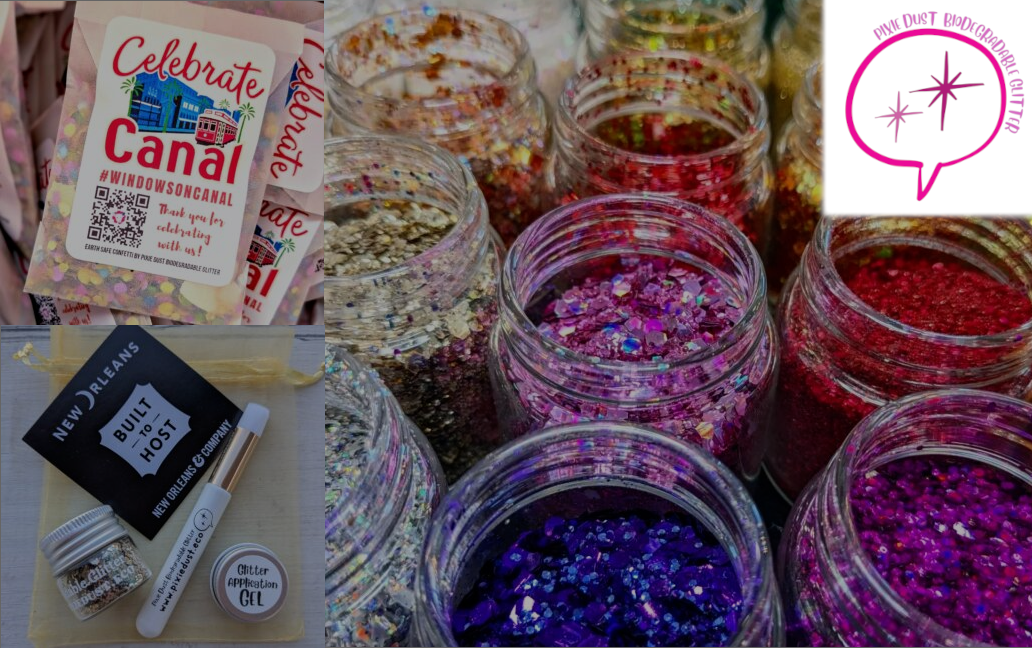
When we arrived in NOLA, we just searched for sustainable businesses or businesses that are participating in sustainability and ecological initiatives. We found Glass Half Full and we found Pixie Dust and a couple of others, but the Pixie Dust story was really the one that resonated. We found your product at a small shop in the French Quarter, Swiet Stuff.
Samantha: I work really closely with Emily at Swiet Stuff. It’s not my store, but she sells my full collection of products and what she’s doing is really cool, too.
Xplore: What’s the story behind Pixie Dust, the name, and who you are and how you got to build your brand?
Samantha: My origin story. I moved to New Orleans right after the Mardi Gras of 2018. Here in New Orleans, you could wear cosmetic glitter as an everyday makeup choice, any day of the week. It’s just a part of our celebratory culture because there’s always somebody here celebrating something. That’s why you come to New Orleans. I was wearing glitter, I loved it, and then I learned that it was microplastics – and I didn’t like that. I didn’t like that it was little bits of plastic. I tried to find a more sustainable product. I went to stores and looked online. Nobody was carrying anything like that. Nobody even knew what I was talking about. They also didn’t know that glitter was made of microplastics. I was educating them. At the time, the only ones that were selling it were based in the UK. They had banned microplastics and they invented biodegradable glitter. There were businesses there and I had to get it from overseas and it took forever to get here. It was very expensive, so I bought it in bulk just to save myself money. I would wear it out and people would comment, “Oh, your glitter is so pretty.” It wasn’t a sales pitch at the time. I would just start a conversation. “Oh, it’s made from eucalyptus. Did you know that glitter is a microplastic?” It started a whole conversation and people were really interested. They were like, “Where do I buy some for myself?”
Samantha: And I would put some glitter on people when I went out and people would be asking, “Do you do parties? Can you come to my wedding? Can you do this?” And so I started doing it. I had a whole set. I bought it wholesale, so I had a whole bunch of glitter at home and started putting it in jars. At the time, my friends were calling me Pixie. So when somebody asked, “What’s your business called?” Pixie Dust just came out of my mouth because it was my nickname. People asked, “Do you have a business card?” Well, guess what happened that week? I went and I got myself a business card. It was very organic. I didn’t know what I was doing. I was just rolling with the punches.
Xplore: You were serving the market demand.
Samantha: Yeah, I was serving the market demand. I got into my first store, a vintage shop called Independence Street. The owner, Jamie, is now one of my really good friends. She was like, “You should put your product in my store.” That was really cool. I put a bunch of products there. At the end of the month, I get a check. I thought, “this is great – let’s try and get into more stores.” It snowballed and my business shifted toward events. Now, seven years later, we just did our first Jazz Fest, which was a huge milestone. I work with some of the very big clients downtown, like the French Market. We just did the Tomato Festival this weekend. I also work really closely with the Audubon Zoo.
Xplore: Incredible! Where do you source the materials?
Samantha: For a very long time it was still the UK. Today, as people in the US have become more eco-conscious, the word’s gotten out that glitter is a microplastic. The secret is out and American glitter manufacturers have started biodegradable glitter lines, which is a huge change. We want every company to change over to making their product more sustainable. So I have many sources here in the US now. It’s made from eucalyptus cellulose film. It’s like the fatty part of the plant, dehydrated plant fat, with natural food coloring dyes. A lot of them are holographic.
Xplore: So it has a prism effect with all the colors, that’s awesome. I remember thinking I wondered what it was made of. We had to leave the store before I got a chance to read the package. I was curious whether the ingredients were mica, like a silicon-based thing, because that could be bad for your lungs, despite being all natural. I’m really glad to hear that it’s cellulose-based.
Samantha: There’s no mica in it and it will biodegrade within six to eight weeks. You’ve got to keep it out of direct sunlight. If I have a jar in direct sunlight, I know my glitter is biodegradable because condensation forms on the inside of the glass. That does not happen with plastic glitter. It’s definitely a plant-based product. It needs those microorganisms to break it down, like those found in soil and wastewater. People ask me all the time if it’s just going to disappear on the floor or if it’s going to dissolve on the skin. It will not, because it’s not sugar or salt based.
Xplore: I love that you filled the need for yourself first very organically and naturally, and then others were excited about it too and you met market interest and demand. I definitely want to highlight that.
I’m also curious about some of the differences from conventional glitter. I think you kind of already touched upon microplastics and the environment. One of the things I was curious about is that glitter is one piece of celebratory material, but I think about streamers, confetti, beads, and all kinds of other sources of plastic. I’m sure you’ve already thought about expanding to other opportunities and maybe you could tell us a little more about that.
Samantha: Yeah, I work with “Grounds Krewe” who does those sustainable Mardi Gras throws, like glass beads and wooden beads and paper beads. They carry our glitter. You could get soap, a toothbrush, or a jumbo mix. They have all kinds of cool goodies that aren’t plastic. They’re usable. It’s not just junk; it’s a useful item. It could be used before it’s discarded.
A lot of the stuff that you get during Mardi Gras, there’s only so many places that you can show off your decorated beads and you end up with a lot of junk. It’s really fun in the moment, but I would much rather catch some fun soap that I’m going to use in my bathroom. That’s really awesome. So we work with them to do those sustainable throws. Then I have my product which you saw in Swiet Stuff, and you could buy all my glitter products in a few stores or online. We also do events, everything from kids’ birthday parties to Jazz Fest.
Before, you mentioned “mindset.” While the microplastics from glitter are a small part of the waste created, when I’m putting glitter on you at a party and I teach you that this glitter on your face is made from plants, not plastic, that puts you in that mindset at the party. You think, “Cool, I’m being eco-conscious right now.” That might snowball into making sure a can goes into the recycling bin.
Xplore: Or, “I’m not going to litter on the ground during this celebration because I’m being eco-conscious right now.” That’s really important because celebrations can make a lot of waste. In terms of your audience, it’s anyone that wants to celebrate but also do it with a sense of good stewardship. What are your growth plans? Where do you see Pixie Dust in five years? Are there other festivals around the country you’re thinking about moving into? What’s your growth trajectory looking like?
Samantha: I would love to teach other people around the country who are interested in my profession to be able to do this in their city. Personally, I don’t plan on expanding past New Orleans, maybe Baton Rouge or Lafayette. But I would love to share. There are other people who are doing glitter. I would love to travel to different festivals that happen in the summer.
I am busy all year long, not just during Mardi Gras. Even in the dead of summer, we still have Pride Fest, Tomato Fest, and New Orleans Food and Wine coming up. New Orleans really keeps you busy. I want to work with LSU and Tulane. There are other well-established glitter providers in the city. I’m not the only glitter business in my city. That’s how much we love glitter here. The city has multiple of the same business with such a niche product.
Xplore: Have you considered franchise models for expanding your business?
Samantha: I haven’t considered that. Maybe in the future I’ll think about what that would look like and if that’s a path I want to go down. I’m pretty content with New Orleans and how big my business is currently. My main goal right now is I would really love to get into more stores. I would love for somebody to walk into a store that sells glitter and there are two options for you to buy: plastic glitter and my glitter. I think it’s really important that consumers have a choice because some people want the sustainable option, or the option that’s safe for kids, or because they have sensitive skin. There’s a million reasons why you would choose one over the other.
Xplore: Many thanks to Samantha Bongiovanni of Pixie Dust Biodegradable Glitter for this interview. You can find biodegradable glitter and more at her website: www.pixiedust.eco