Visibility feels like progress. Your impressions increase. Website traffic rises. More people see your content, click your advertisements, or encounter your destination in search.
But attention is not the same as intent—and intent is not the same as action.
That gap is where many tourism, hospitality, eco-destination, and real estate brands lose momentum. Marketing channels are managed separately. The website behaves like a digital brochure. Social media creates activity without a clear next step. The booking or inquiry system is expected to complete the sale without enough context, proof, or trust.
The Xplore Visibility-to-Booking Framework connects the customer journey through four essential stages: Discover, Attract, Engage, and Convert.
Its purpose is simple: help the right people find you, understand why you fit, trust what you offer, and take a clear next step.
Why more marketing is not always the answer
When bookings or inquiries slow down, the natural reaction is often to publish more content, launch another advertising campaign, or increase the budget.
That may create more activity. It can also amplify the problems that already exist.
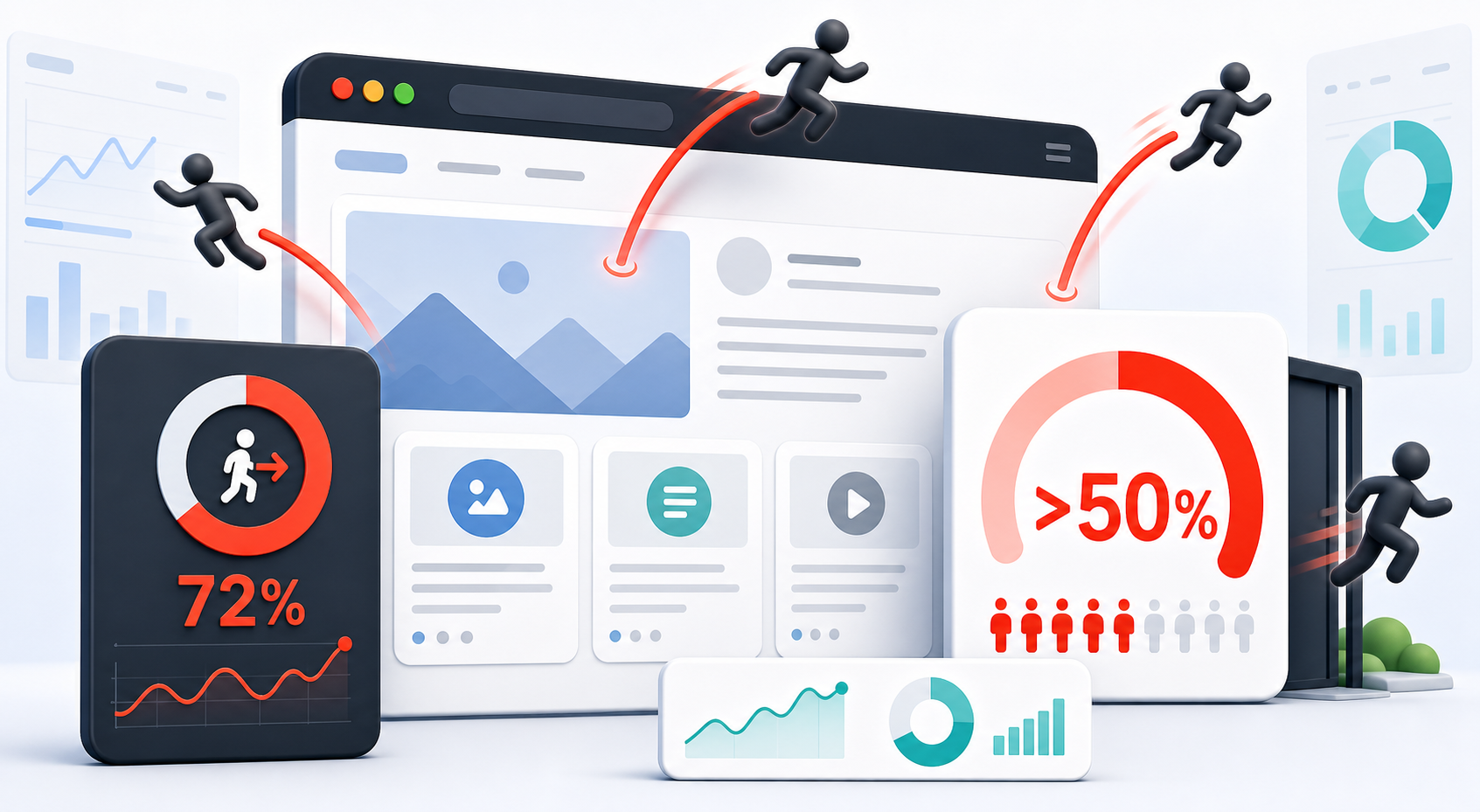
If your positioning is unclear, more traffic introduces that confusion to a larger audience. If your landing page does not match the campaign promise, additional clicks create additional exits. If your booking experience is slow or difficult, increased advertising simply sends more prospects into a leaking funnel.
Before adding volume, ask:
- Are we visible for the questions and searches that indicate genuine buying or booking intent?
- Can a first-time visitor quickly understand our best-fit experience?
- Does our content provide enough proof to reduce uncertainty?
- Is the path to inquire, book, visit, or buy obvious?
- Can we connect marketing activity to qualified leads, bookings, and revenue?
The Visibility-to-Booking Framework gives each question a place—and gives your team a practical order in which to act.
Discover: Find the gaps before your customers do
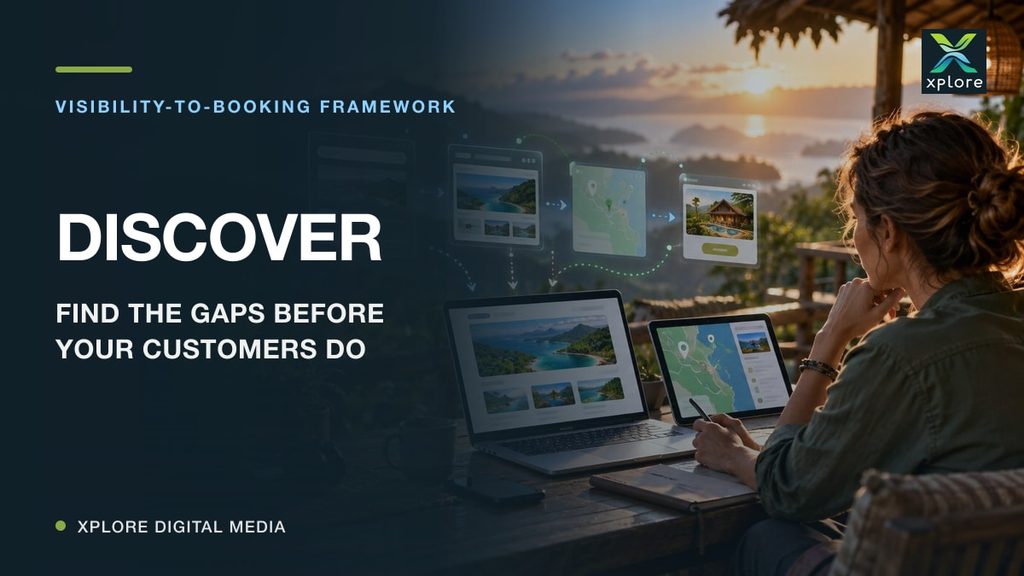
Discovery is the diagnostic stage. It prevents your business from investing in the wrong solution.
Start by reviewing the experience through the eyes of someone who does not already know your property, destination, attraction, development, or service. Search for the problems you solve. Compare what appears. Visit your website on a phone. Try to locate pricing, availability, policies, contact information, and the next action.
Look across five areas:
- Audience: Who is most likely to value and book this experience?
- Intent: What are they trying to decide at this moment?
- Message: Is the reason to choose you specific and easy to repeat?
- Journey: What questions or friction could stop the next step?
- Measurement: Can you connect activity to inquiries, bookings, or revenue?
The output of Discovery should not be a large report that sits untouched. It should be a short, prioritized map of the opportunities most likely to improve traffic quality, trust, and conversion.
Attract: Show up when the right people are choosing
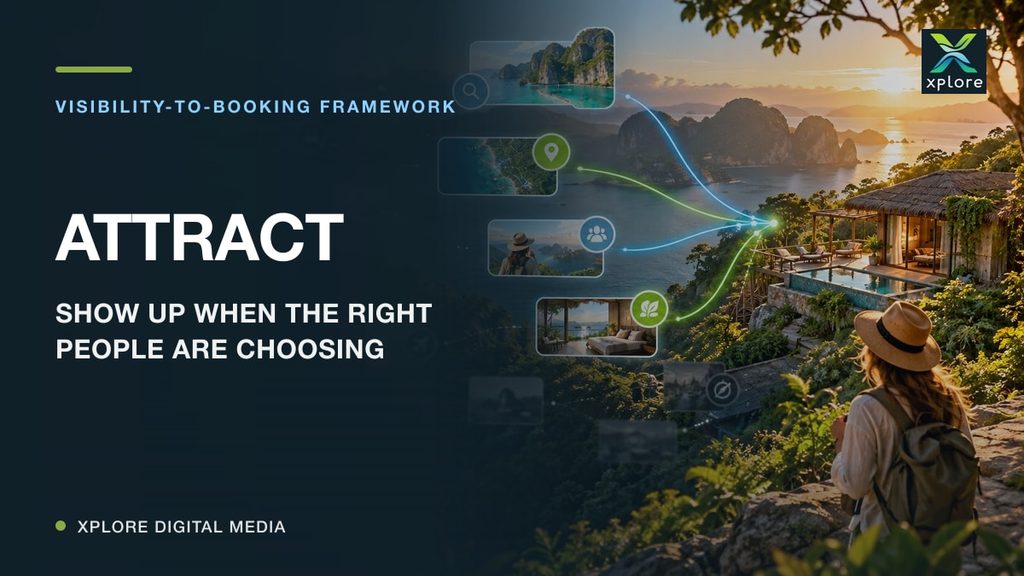
Attraction is not about building the largest possible audience. It is about earning visibility at useful moments.
A broad search such as “glamping” may create awareness. A search for “pet-friendly glamping near Asheville with a private hot tub” reveals much more about fit and readiness. The same principle applies to destinations, tours, retreats, attractions, sustainable developments, and real estate opportunities: specificity helps the right prospect recognize themselves.
Build attraction around three layers:
- Demand capture: SEO, paid search, local search, maps, directories, and destination pages.
- Demand creation: social content, partnerships, editorial storytelling, email, and campaigns that introduce a reason to care.
- Machine understanding: clear page structure, consistent business information, descriptive copy, and structured data that help search and AI systems understand what you offer.
The goal is not traffic for its own sake. A smaller stream of well-matched visitors can create more opportunity than a surge of people who were never likely to book.
Engage: Turn attention into confidence
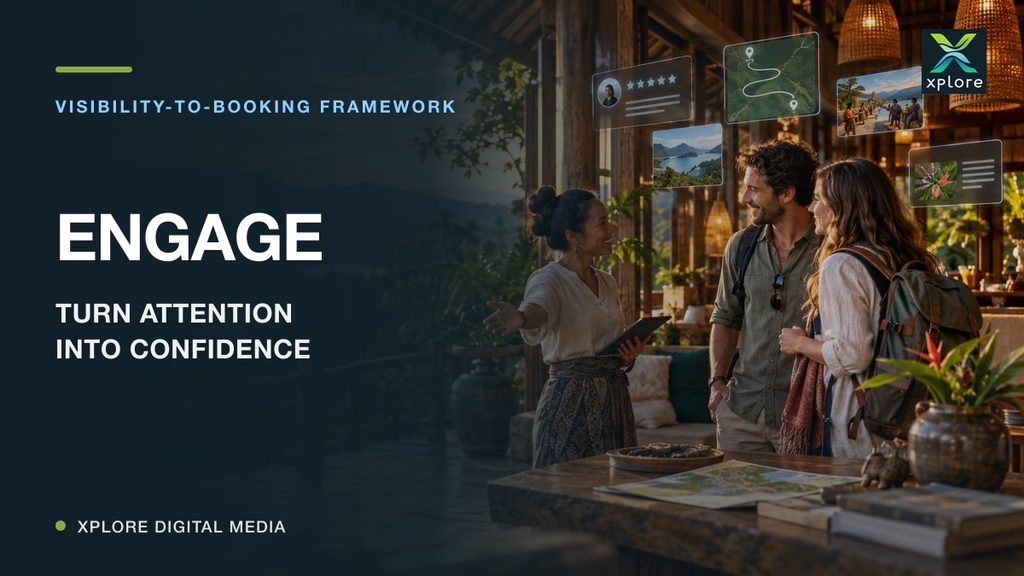
Tourism and hospitality experiences are purchased before they are experienced. Prospective guests must imagine the stay, understand the practical details, trust the promise, and feel comfortable with what they cannot inspect in advance.
Engagement is where your content answers the questions a booking button cannot:
- What will this experience actually feel like?
- Is it right for people like me?
- What makes it meaningfully different from the alternatives?
- Are the location, amenities, accessibility information, pricing, and policies clear?
- Are the sustainability or community-impact claims specific and credible?
- What have previous guests, visitors, buyers, or partners experienced?
Useful engagement assets include detailed accommodation or experience pages, authentic guest stories, sample itineraries, current reviews, FAQs, comparison guides, local expertise, team profiles, clear policies, and transparent impact reporting.
Every piece of content should have a job. It might move a visitor from inspiration to planning, planning to comparison, or comparison to action.
Content without a relevant next step becomes an attractive dead end.
Convert: Make the next step easy to say yes to
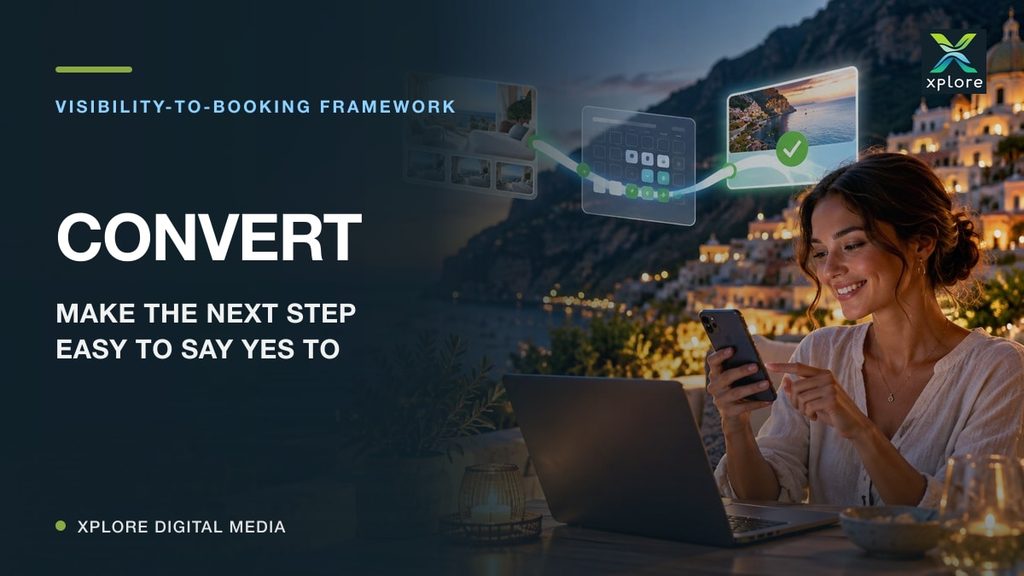
Conversion is the point where interest becomes a measurable business outcome: a direct booking, qualified inquiry, tour request, consultation, event registration, property visit, or purchase.
The final step should feel consistent with everything that came before it. If your website promises a premium, welcoming experience but the booking engine feels slow, unclear, or unexpectedly expensive, trust breaks at the moment it matters most.
Review the conversion path for:
- a visible and specific call to action;
- a fast, mobile-friendly booking or inquiry experience;
- clear availability, pricing, inclusions, fees, and policies;
- useful trust signals close to the decision point;
- minimal unnecessary fields and clicks;
- accessible contact or support options;
- a confirmation that clearly explains what happens next;
- reliable tracking from source to business outcome.
Conversion optimization is not about adding pressure. It is about adding clarity and removing friction.
The handoffs matter as much as the stages
Even strong individual channels can fail when they do not connect.
SEO may attract a high-intent traveler, but the landing page does not answer the original question. A social post may create interest, but there is no relevant page to continue the journey. The website may build confidence, but the booking engine introduces unexpected fees. The analytics report may show clicks, but not whether those clicks became qualified inquiries or revenue.
Audit the handoffs:
- Discover to Attract: Are priorities based on audience evidence or internal assumptions?
- Attract to Engage: Does every campaign lead to the most relevant page and message?
- Engage to Convert: Does the content make the next step clear and credible?
- Convert to Improve: Do confirmed outcomes return to your reporting so the next decision becomes smarter?
The strongest growth systems do not treat SEO, advertising, content, social proof, landing pages, booking technology, and analytics as separate projects. They connect them around the customer’s next decision.
Put the framework to work this month
Choose one priority audience and one valuable outcome. Do not attempt to map your entire business at once.
Choose one customer journey
Define the audience, their motivation, their likely starting point, and the outcome you want them to reach.
Walk the journey yourself
Search as that person would. Open the result on a phone. Read the page. Check availability or complete the inquiry process. Record every unanswered question and moment of hesitation.
Fix the highest-impact handoff
Align a campaign with its landing page. Add missing proof. Clarify the offer. Correct inconsistent information. Simplify the booking action.
Measure what happens next
Confirm that important actions are tracked. Review traffic quality, movement to the next step, completed outcomes, and the points where qualified visitors leave.
Use this statement to define the improvement:
If we improve [touchpoint] for [audience], we expect more people to [next action], which we will measure using [business signal].
Continue the conversation inside Xplore Basecamp
The Visibility-to-Booking Framework becomes more valuable when you apply it to a real customer journey.
Inside Xplore Basecamp, members can access practical Deep Dives, member seminars, implementation resources, industry conversations, and Ask Xplore” space to bring current marketing, website, visibility, and booking questions to the community.
Bring one journey you want to improve. Share the audience, touchpoint, and friction you found. The goal is not to perfect the entire system at once. It is to identify the next improvement most likely to move a qualified prospect forward.
Join the Xplore Basecamp Community
Ready to find your clearest growth opportunity?
Xplore Digital Media helps tourism, hospitality, eco-destination, and real estate brands turn a scattered online presence into a clearer path from first search to real inquiry or booking.
If your business is receiving attention but needs better leads, more direct bookings, or a more measurable customer journey, start with a focused review of what is working, what is missing, and what may be costing you opportunity.
Explore Xplore™ Services
Request a Growth Strategy Conversation